The new National Planning Policy Framework brings vision-led transport, infrastructure, clean energy, healthy communities and long-term placemaking into much closer conversation. For Zimbl Co-Founder and Chief Strategy Officer Jan Simmonds, the interesting question is what happens when we join the delivery model up too.
I’m not a planner, I’m an entrepreneur. But after several years spent trying to solve many of the challenges the new NPPF is now wrestling with, it’s exciting to see some of our vision for the built environment coming into focus through the national lens.
I have spent a fair amount of time with the new Framework. Perhaps more than is entirely healthy. And the more I read it, the more one idea kept returning.
We have become very good at solving the individual components of a place. Perhaps the next challenge is joining them together.
Liveability, energy, active travel, shared mobility, public realm, community infrastructure, charging, storage and digital connectivity are still commonly designed, funded, procured and operated through different workstreams.
That is understandable. Each requires genuine expertise.
But residents don’t experience workstreams. They experience a place.
Interestingly, the NPPF itself starts from a similar premise. Its economic, social and environmental objectives are described as interdependent and to be pursued in mutually supportive ways. The economic objective specifically includes identifying and coordinating the provision of infrastructure; the social objective speaks to strong, vibrant and healthy communities with accessible community facilities; the environmental objective includes moving to a low carbon economy.
That is not Zimbl language. It is national planning policy.
And it raises a question that sits right at the heart of what we have been trying to build.
The elephant in the masterplan
There is a tension in creating new communities that everybody around the table understands.
Planning authorities understandably want infrastructure and community facilities delivered early. Residents quite reasonably expect the services, amenities and connectivity that helped define the vision for the place they are buying into.
Developers, meanwhile, face a commercial reality. Cafés need customers. Mobility needs users. Community facilities need funding. Energy infrastructure requires capital. Every additional operator, building and obligation introduces another interface, another cost and another risk.
Deliver these things too late and the community loses. Deliver them too early, or in the wrong form, and the economics can fail.
What if that tension is actually a design problem?
One passage in the Framework particularly caught my attention. Policy HO4 says strategic housing sites should be capable of being supported by the necessary infrastructure and facilities “at appropriate points in the development’s delivery”.
Those six words matter.
Because appropriate does not necessarily mean everything on day one. Nor should it mean the infrastructure that makes a place function arriving years after the people who need it.
It suggests something more intelligent; phasing.
HO4 goes on to require strategic sites to be capable of supporting sustainable communities, with access to services and employment, and asks local plans to set clear expectations for the quality of places through tools including masterplans and design codes.
The commercial opportunity, in my view, is to ask whether the infrastructure itself can be designed around that phasing.
Instead of treating community space, café, workspace, mobility, charging, energy and local services as separate obligations, with separate operators and separate economics, could complementary uses be brought together so that each helps the others become viable?
Could a relatively simple intervention arrive early, then expand as occupation and demand grow? Could the developer spend money more efficiently, the planning authority see meaningful infrastructure delivered earlier, and residents get the place they were promised?
There is another part to that equation. Developers are very good at building places; they should not necessarily have to become long-term operators of everything within them. If infrastructure that already needs to be provided can be brought together, funded through the development and supported through its early years while occupation grows, it creates the possibility of a much cleaner handover to an operator whose job is to stay.
We don’t help developers avoid their obligations. We want to help make those obligations work.
That distinction matters. Good placemaking and developer profitability do not have to sit on opposite sides of the table.
From transport planning to place planning
The transport chapter contains another significant shift.
TR1 requires sustainable transport to be considered from the earliest stages of plan-making and made integral to the strategy for creating well-designed, sustainable, inclusive and popular places. It calls for early engagement not just with authorities and communities, but with transport infrastructure providers, operators and land promoters.
It also asks strategic sites to support an appropriate mix of uses to reduce the number and length of journeys, and specifically recognises public transport hubs and electric vehicle charging among the facilities that may need to be planned for.
The phrase that matters most, though, is vision-led.
The Framework defines this as setting the outcomes we want for a development, then providing the transport solutions required to deliver them, rather than simply predicting future demand and providing capacity for it.
That feels like an important change.
But there is an interesting challenge for shared mobility within it.
TR4 quite properly puts walking, wheeling and cycling first, followed, so far as possible, by easy access to high quality public transport. Shared mobility should not compete with that hierarchy. Done well, it should help make it possible.
TR2 is particularly interesting here. It explicitly connects maximum parking standards with shared transport and asks planners to consider car sharing and other schemes that may reduce vehicle parking requirements.
That matters because parking is not free. It consumes land, capital and ultimately value.
If a combination of active travel, public transport and genuinely useful shared mobility can reduce the need for every household to own multiple cars, the conversation stops being simply about transport. It becomes a conversation about land efficiency, density, public realm and the quality of place.
Shared mobility is not the objective. Choice is.
POWER + MOBILITY + COMMUNITY
Our own journey at Zimbl began with operating door-delivered shared electric mobility and learning how people actually use it.
That operational experience changed our thinking.
We began to see mobility not as an isolated service, but as one part of a wider ecosystem. That evolved into three connected pillars; POWER + MOBILITY + COMMUNITY.
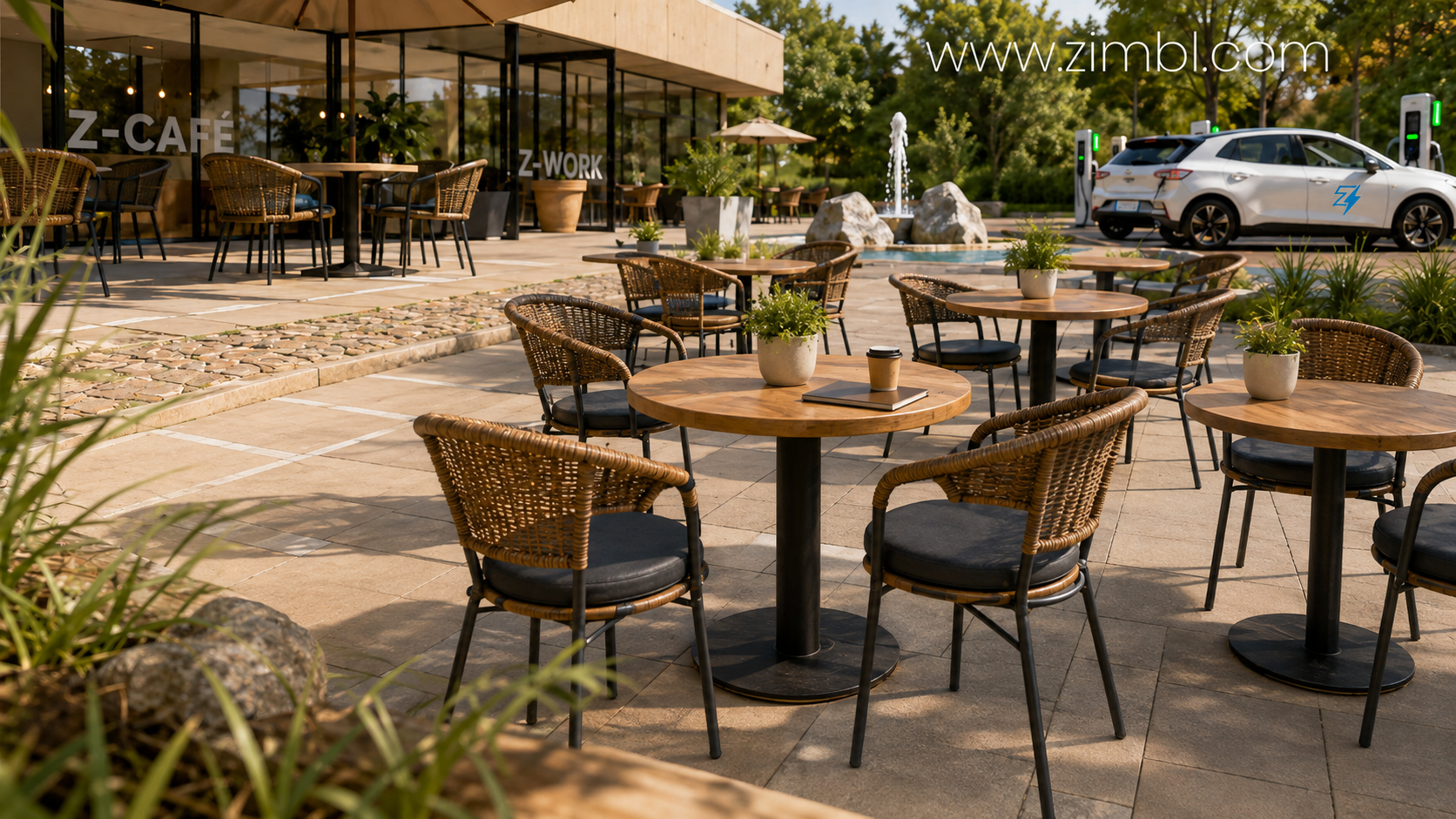
POWER can bring together renewable generation, energy storage, smart energy management and EV charging. MOBILITY can combine active travel support, shared vehicles, charging and connections into wider public and shared transport. COMMUNITY provides the human layer; somewhere to meet, work, eat, collect things, access services and simply spend time.
The precise mix should vary by place. That is important.
A Z-Hub should not be an identikit building dropped onto every masterplan because a spreadsheet says 1,500 homes require one. The physical response should reflect the community, the site, the planning requirements, the phasing and the commercial opportunity.
What interests me is how closely the energy side of the new Framework begins to intersect with this thinking.
W1 calls for early engagement between planning authorities, utility providers, regulators and network operators, specifically so that energy supply, network capacity and future infrastructure requirements are understood before they become constraints. It asks for those considerations to influence the location and phasing of growth.
W2 then moves into renewable and low carbon energy, electricity network infrastructure and opportunities for decentralised energy. W3 gives substantial weight to benefits including energy security, economic development and the transition to net zero, while recognising the economic and social benefits of small-scale and community-led energy.
Even the glossary is worth reading. Battery Energy Storage Systems, both long and short duration, are explicitly included within the Framework’s definition of renewable and low carbon energy.
At Zimbl, that feels very familiar.
The opportunity is not simply to put an EV charger next to a community building and call it integration. It is to think about energy, mobility and community infrastructure as parts of the same operating ecosystem.
The bit you can’t see
Physical integration, however, is only half of the idea.
The communities we are masterplanning today may still be delivering homes in the late 2030s. Nobody around the table can confidently predict what mobility, energy, logistics or community services will look like by then.
Nor should they have to.
Future-proofing isn’t predicting the future. It’s creating the physical and digital architecture capable of accommodating it.
That is why Z-APP matters to us.
Our ambition is for the app to become the digital glue connecting the Zimbl ecosystem. For a resident, that means one relationship with their place rather than an assortment of unrelated apps, accounts and operators. For the developer, asset owner and operator, it creates the potential for services and infrastructure to evolve as the community grows.
The possibilities extend well beyond what we operate today.
Autonomous vehicles will eventually need somewhere appropriate to arrive, wait, charge and interact with people. Drone and robotic delivery will need managed points of exchange rather than simply adding another layer of chaos to residential streets. Intelligent energy systems will increasingly balance generation, storage, charging and demand. New forms of last-mile logistics and demand-responsive transport will emerge.
Interestingly, even last-mile delivery is visible in the Framework. Its economic policies refer to the need for facilities and infrastructure supporting freight and logistics, including last-mile deliveries, transport innovation and decarbonisation.
We do not need to know precisely which technologies will win.
We need to create places capable of accommodating them.
That, to me, is a more useful definition of future-ready.
From obligation to ‘Legacy’.
Perhaps this is where the opportunity becomes most interesting for developers and planning authorities.
Section 106 obligations and other planning requirements exist for good reason. Growth creates infrastructure needs, and communities should benefit from development.
But an obligation that cannot sustain itself is not necessarily a successful outcome. A building can be delivered and still fail as a place. A mobility scheme can exist and still be irrelevant to residents. A café can be provided and still close. A charging asset can be installed without being integrated into the wider energy strategy.
The better question is not simply whether the infrastructure was delivered.
Did it work?
If complementary uses can share land, buildings, energy, customers, data and operational overhead; if they can be phased as occupation grows; and if one operator can remain engaged from masterplanning through delivery and into the life of the community, then perhaps the economics begin to change.
The planning authority gets something meaningful earlier. The developer gets a more efficient route to delivering it. Residents get infrastructure that is designed around how they actually live.
And the infrastructure itself has the opportunity to become a productive, managed asset rather than a collection of stranded obligations.
That opens up a different delivery model. The developer can fund the infrastructure as part of creating the place, support its early operation while the community grows, then hand the asset into long-term ownership or control by an operator whose interests remain aligned with the community. The planning authority gets continuity, residents get permanence, and the developer can move on knowing the infrastructure it promised has a viable life beyond practical completion.
A different conversation
The new NPPF will not solve these questions for us. Nor should it.
But I find the direction fascinating.
Vision-led transport. Infrastructure at appropriate points in delivery. Mixed uses that reduce the need to travel. Shared transport considered alongside parking and density. Energy capacity and phasing considered early. Community-led energy. Healthy, well-designed places. Flexibility for strategic sites to respond to changing infrastructure requirements, viability and design.
Read individually, these are planning policies.
Read together, they begin to describe a system.
I am not a planner, and I would not presume to tell people who have spent their careers shaping places how to masterplan them.
But entrepreneurs tend to look at interfaces. We ask why one thing stops where another begins, whether two costs could become one asset, or whether a problem everyone has learned to live with might be configured differently.
After several years spent doing exactly that at Zimbl, it is exciting to see some of our vision for the built environment coming into focus through the national lens.
We certainly did not set out to anticipate planning policy.
But it is rather nice to see the two beginning to converge. 😉
Perhaps the next evolution in masterplanning is not more infrastructure.
Perhaps it is better integration; physical, operational and digital.
And perhaps, designed properly, community infrastructure can become part of a developer’s legacy rather than simply another obligation to discharge.
That is a possibility we are rather excited about at Zimbl.
Jan Simmonds
Co-Founder & Chief Strategy Officer, Zimbl