By Jan Simmonds, founder and Chief Strategy Officer, Zimbl
The built environment is entering a new era. For decades, we have designed places around static assumptions: every household will own one or two cars; energy will arrive from the grid when it is ready; and “community” will appear once the last scaffolding comes down.
But those assumptions are failing, economically, environmentally and socially. Housebuilders and developers are under pressure to cut embedded and operational carbon, respond to changing travel behaviours, meet planning obligations, and still deliver places people actively want to live and work in. At the same time, investors are searching for scalable, defensible propositions that sit at the intersection of real assets and technology.
Zimbl exists because these pressures are converging. Our ambition is simple: to turnspaces into places with smarter energy, mobility and community.
The built environment meets platform thinking
Zimbl is not a single service. From unique ‘delivered’ multi-modal, hourly shared mobility, to smart-grid energy solutions and own branded or partnered hospitality, retail and management company services, Zimbl is a ‘one-stop-shop’ for the built environments of the future.
What differentiates Zimbl is that we treat the built environment as a connected system. Mobility choices affect parking demand and land value. Energy strategy affects the viability of electrified transport and resilience. Community amenities affect footfall, wellbeing, local spend and long-term retention. And when these elements are orchestrated through a digital layer, the place becomes measurably smarter over time.
Proven in the real world, ready to scale nationally
Zimbl was launched by the founders as the first rental company in the UK or Europe offering an hourly, delivered, off-grid (HVO-powered) all-electric vehicle fleet. In our pilot in Banbury, Oxfordshire, the model has scaled to a fleet of fifteen off-grid-charged vehicles, more than 2,500 users and over 7,000 bookings. More importantly, Oxford University-validated research from Banbury shows that over 20% of Zimbl users have avoided purchasing a car because the service exists.
That single behavioural outcome is a quiet revolution for housebuilders and planners. If you can credibly reduce second-car demand, you create optionality: fewer parking bays, more developable land, better public realm, and a planning narrative grounded in evidence rather than aspiration. Zimbl is now scaling up with plans to roll out 40+ Zimbl hubs (Z-Hubs) in housing developments across the UK, alongside an active development pipeline that exceeds 75,000 homes.
A proposition designed around the needs of decision-makers
We built Zimbl to serve the full spectrum of built environment stakeholders, and to be deployable in formats that match real-world constraints.
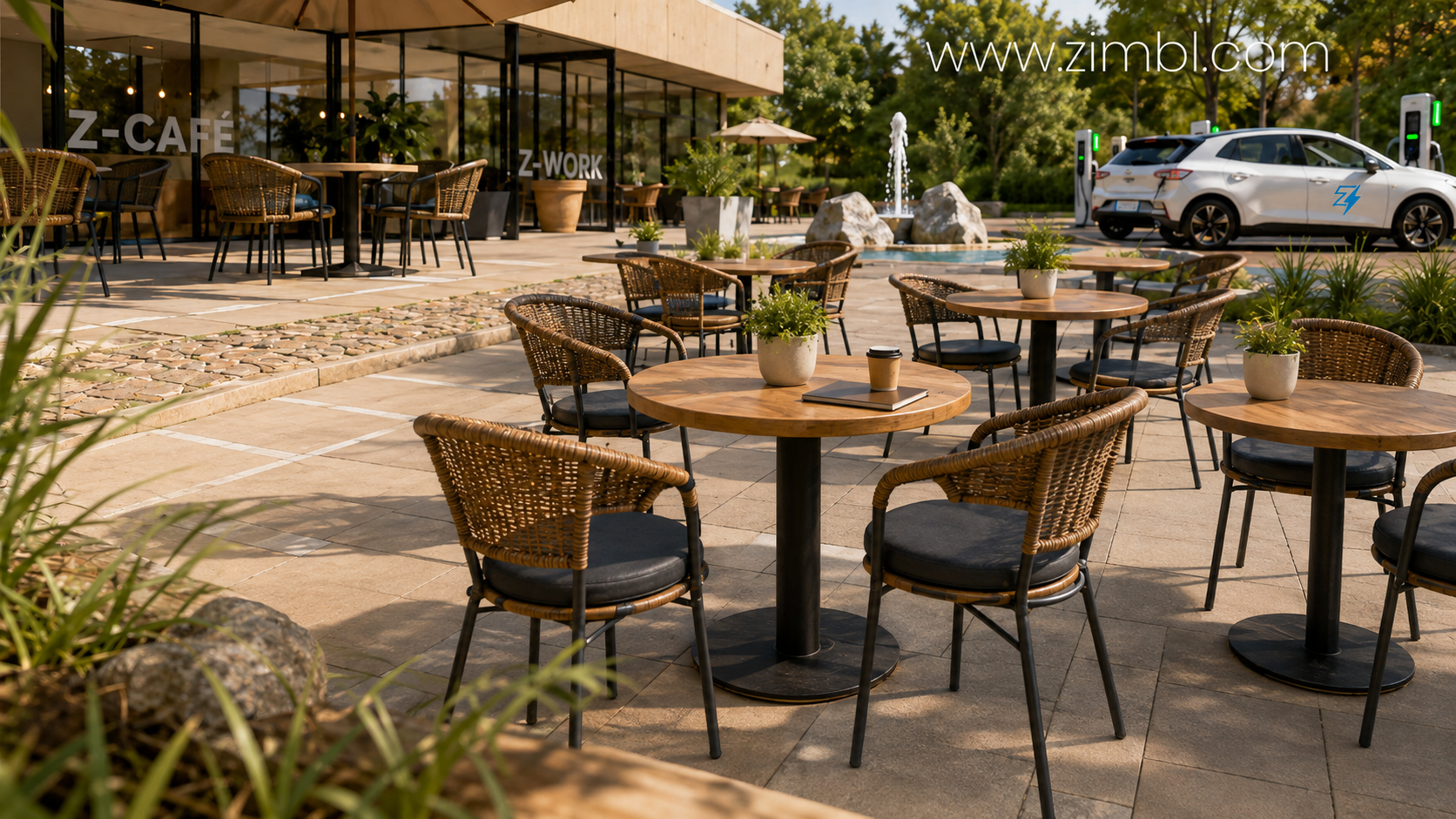
For housebuilders and residential developers, Zimbl strengthens sustainable transport strategies and supports section 106 outcomes, while acting as a destination magnet that boosts placemaking and buyer appeal. The Z-Hub is our flagship – a fully Zimbl-branded, Zimbl-operated mobility and community destination that combines EV hire and charging with a café, co-working, a farm shop-style retail offer, e-bikes, e-taxis and last-mile delivery.
For commercial developers and property landlords, Zimbl delivers a practical way to electrify mobility, provide charging, and enhance tenant experience without creating operational headaches. We design, build and operate the ecosystem, providing a single point of accountability across mobility, energy, maintenance and service delivery.
For the corporate sector, the need is increasingly clear: reliable, sustainable transport and power, often across multiple sites, with reporting that stands up to board scrutiny. Zimbl’s model supports corporate campuses, film and television production, construction projects and temporary sites, pairing managed EV fleets with charging and off-grid power where required.
The technology layer that turns infrastructure into advantage
Beneath every Zimbl deployment is our tech platform, the Z-App, the single digital layer through which residents, workers and visitors access services across mobility, energy and community. It is designed to feel as simple as booking a taxi, but underneath it orchestrates a complex ecosystem in real time, from EV availability to charging visibility and community services.
For development partners, the Z-App does something even more valuable: it creates a living operational dashboard. It captures utilisation, carbon savings, modal shift and community engagement, and feeds those outputs into ESG reporting and digital twinning – converting planning commitments into demonstrable outcomes. This is where the built environment meets the latest technology in a way that is genuinely useful, not gimmicky. Data is captured securely and anonymised, but its strategic value is profound because it reflects how communities actually behave, not how we hope they will.
An investor proposition built for the future
Our model creates multiple, compounding revenue streams: consumer and corporate bookings, chargepoint usage, energy services and community amenity revenues, alongside the longer-term potential for SaaS licensing and data-driven reporting as the network grows.
We are also designing for what comes next. Every Z-Hub is autonomous-ready – built to accommodate the transition to autonomous mobility as the technology matures, future-proofing assets beyond the immediate planning cycle.
A new kind of place-making partner
Zimbl is ultimately about outcomes: better places, lower carbon, less car dependency, stronger communities, and more resilient assets. Our mission is to reimagine communities, reshape local mobility and repower buildings, with a tech-driven backbone that makes results measurable and repeatable.
The built environment is ready for a step change. The next big thing will not be a single product or a standalone technology. It will be an integrated ecosystem. Designed, operated and continuously improved. That is the opportunity Zimbl was created to seize.